
Ausbildung in Germany: A Guide for Indian Students (2026)

Most international students worry about spending lakhs on tuition fees and student loans, while a growing number of students are choosing a more practical route by studying in Germany for free.
Ausbildung is Germany’s free education system that combines theory with practical on the job training. Vocational training programs like Ausbildung help students study for free at vocational school (Berufsschule) and earn a monthly allowance (Ausbildungsvergütung) by working at a German company.
This guide covers everything you need to know about the Ausbildung program – vocational training, eligibility criteria, documentation, visa process, and frequently asked questions.
We simplify Ausbildung for you and help make your decision easier.

What is Ausbildung in Germany?
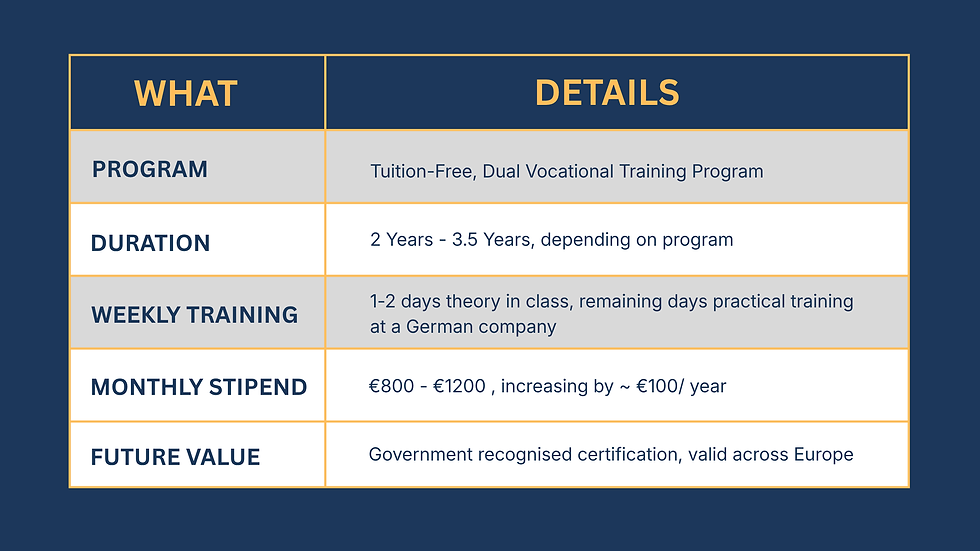
Ausbildung pronounced (ows-bil-doong) is a government recognised, tuition-free, vocational training program. What does that mean? It is a dual education system that combines studying theory at a vocational school (Berufsschule) with practical paid training at a German company.
In the program, students train to develop practical industry relevant skills while working at a German company for which they earn a monthly stipend. As a result, trainees graduate job ready without needing additional internships or work experience after completing the program.
Duration: Most programs are 2 to 3.5 years in duration, depending on the field you select.
Schedule: students spend 1 -2 days a week in a classroom learning theory and remaining days working at a private German company.
Stipend: The Ausbildung allowance also called (Ausbildungsvergütung) ranges from €800 to €1,200 per month, depending on the choice of Ausbildung and training year of the trainee. The stipend increases by €100 each year.
Government Recognised: Ausbildung is government recognised and the course is regulated by the Chamber of Commerce and Industry (IHK) and the Chamber of Crafts (HWK).
Value: It is a highly valued and recognised certification across all of Europe and not just Germany.
Future: Nursing Ausbildung (Pflegefachmann/-frau), logistics management Ausbildung, mechatronics and hospitality Ausbildung have the strongest demand and stipend levels (more on this in the following section).
Why should I choose Ausbildung?
Unlike a traditional bachelor's or master's degree, the Ausbildung program combines classroom learning with paid, hands-on vocational training. With no tuition fees and a monthly stipend from the start of the program, students graduate with practical work experience and job-ready skills.
Here are a few key benefits that make Ausbildung a popular choice amongst international students looking to study abroad.
Benefits of an Ausbildung in Germany
Free of cost Education: Ausbildung is free of cost. There are no applicable tuition fees for students.
Earn as you Learn: Trainees earn up to €1200 per month for on the job training while also studying theory at vocational school.
Lower Cost of Living: Many Ausbildung programs offer free or low cost accommodation to trainees, and their Ausbildung stipend covers for most of their living cost in Germany.
No Blocked account - Students generally do not need a blocked account amount to enrol in the program.
High Demand for Skilled Workers: Germany is actively employing candidates from different countries into their workforce, this creates a good opportunity for Indian aspirants to build a high - paying career in Germany.
Strong Career Opportunities: Many trainees get full-time jobs after completing the program with an average Ausbildung salary of €2,200 per month, depending on the profession and location.
Ausbildung is Government-Recognised: The certification is highly valued and recognised by employers across Europe, not just in Germany.
Pathway to Permanent Residency: students are eligible for permanent residency after 5 years of stable employment, allowing them and their families to build a future in Germany.

What is the eligibility for Ausbildung?
The eligibility criteria for Ausbildung in Germany is straightforward and accessible for many international students. While requirements vary by choice of Ausbildung, most applicants need to meet a few basic qualifications before applying.
Qualification: Most Ausbildung programs require students to complete grade 12 as a mandate for admission. However, healthcare and technical Ausbildung programs may need a science background in grade 12 or bachelors in science to qualify.
Age: There is no upper age limit for enrolment, but almost all Ausbildung programs prefer to accept candidates within the age of 18 to 34 as employers show a slight preference towards recruiting candidates under 27, especially for physically challenging programs.
Language: Ausbildung applicants must hold a German language certification of B1 level from recognised institutes like Goethe-institut, Telc or OSD. ( external linking) Nursing Ausbildung programs require candidates to german language upto B2 level, given the communication demands of patient care.
Although the eligibility for Ausbildung seems simple, the specifics vary by field, use our free eligibility checker to check if you qualify for your chosen Ausbildung program.
What is the Ausbildung application process?
The Ausbildung application process involves several steps, from choosing the right profession to securing a training contract and applying for a German visa. Here's a step-by-step overview of how it works.
Step 1: Choose the Ausbildung program that best suits your skills and interest and research the program specific requirements. Nursing, IT, logistics, and mechatronics have different language, age, and academic requirements.
Step 2: Learn German language, aspirants take close to 6-9 months to learn german up to B1 level and many Ausbildung programs require students to learn the language up to B2 level. We advise students to start learning the language as soon as possible and get their B1 certification from recognised institutes like Goethe, Telc or OSD.
Step 3: Get your Aubildung documentations, pre medical screening and B1 certification ready for the visa application and program enrollment, attend your 1st round of interview where they check your language proficiency, issue the Ausbildung contract, followed by a 2nd round of interview before departure.
Step 4: Fly to Germany, a new beginning is awaiting you.
What are the documents and visa requirements for Aubsildung?
Keep this as your master checklist, but some Ausbildung programs may require more documentation, check our Ausbildung documentation guide for detailed information.
We advise students to start collecting 3–4 months before they plan to apply.
Valid Passport: Minimum 6 months' validity beyond your intended stay
Signed Contract and Health Insurance: Applicants require a signed contract also called (Ausbildungsvertrag) from the German employer or school.
German Language Certification: B1 level German language certification from recognised institutes like Goethe Institut, Telc or OSD is a mandatory requirement for the Ausbildung program. Some programs may even need a B2 certificate.
Academic Qualifications: Students must have attested and original copies of their class 12 / diploma certifications.
Biometric Photographs: Candidates are required to click photographs as per german visa requirements.
German Visa Form: All candidates are required to fill the national visa application form.
Motivation Letter and CV: Candidates are required to write a letter of motivation stating why they would like to enrol into the program and submit their latest CV.
Travel Health Insurance: Candidates are required to procure a travel health insurance for Visa applications.
Indian trainees can apply for a Type D visa i.e a national long stay visa, under the German Residence Act (Aufenthaltsgesetz).
Visa Type: On the Type D visa students are allowed enrollment into their vocational training program and granted stay for the entire tenure of the program, they can additionally take up another job in an unrelated field of up to 20 hours per week. Students must note that this visa category doesn’t allow families to visit on the same visa.
Application and Requirements: Applicants can apply through the CPS portal or VFS in major tier 1 Cities across India like Mumbai, Chennai, Bangalore. Aspirants are required to have their signed Ausbildung contract in hand before most visa application appointments. A B1 level / B2 level certification is mandatory for Visa application along with other documentation required by your employer. Applicants must preserve all documents from the Visa application for permit conversion once they land.
Timeline: The visa application process typically takes 6 to 12 weeks of processing time.
After the program ends and the applicant passes the IHK final exam, they become eligible for a 18 month job seeker residence permit allowing them to eventually apply for permanent residency and settle in Germany.

Frequently Asked Questions
Is Ausbildung actually worth it?
It's a government-backed pathway to build a high paying career in Germany. That said, "worth it" depends on your goals: if you want a hands-on career with fast financial independence and a clear pathway to settle in Germany, Ausbildung provides a practical way to achieve both. However, if your professional priority is a research-heavy academic career, a Bachelor's/Master's route may fit better.
Can I actually get permanent residency in Germany after Ausbildung?
Yes, after the program candidates can apply for a 18 month work permit visa, following which applicants must complete their qualifying years toward a settlement permit. It isn't automatic or instant, and the exact timeline depends on your visa category, income, and integration requirements (including German proficiency), so treat "PR" as a multi-year outcome.
Do I need German before I apply, or can I learn it after I get there?
You need it before you apply — B1 (or B2 for healthcare) is generally required to sign a training contract and get your visa approved. Learning "after arrival" isn't how the process works for the standard Ausbildung visa.
Can I do an Ausbildung after completing my bachelors degree?
Yes, you can apply for an Ausbildung program after completing your bachelor's degree.Most Ausbildung programs accept candidates who have passed Grade 12, however some fields like healthcare and IT require a science background / bachelors in that specific field as a mandate to the application.
Is the Ausbildung stipend enough to live in Germany?
Yes, the Ausbildung salary is generally enough for students to live in Germany. Some Ausbildung programs provide low cost / free accommodation to trainees further reducing the cost of living for students. The key to saving and living well within the Ausbildung stipend also depends on the students budgeting and money management skills.


Comments